Kids Safety Stair Railings
Kids Safety Stair Railings
Exterior Railings & Handrails for Stairs, Porches, Decks
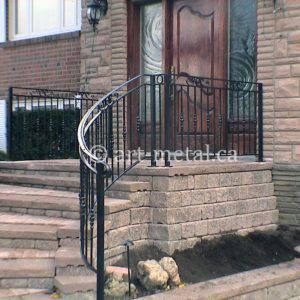
Art Metal Workshop, Inc. offers railing systems for stairs, porches, decks, and others. Whichever your railing requirements and preferred materials are, Art Metal will deliver. With 28 years in the industry, our company has provided quality output to our satisfied customers.
We build quality railing systems using various materials such as aluminum, glass, wrought iron, steel, and wood. Not only we provide delicately-made railing designs, but also we offer our products at the most cost-efficient prices.
Plus, our products are featured in several media outlets these past few years – proof that Art Metal is the company you can trust when it comes to your railing systems needs!
Exterior railings and handrails for stairs, porches, decks, and more Railings come in different designs, built, and material, yet serves a common purpose: to provide safety and security among property owners, and enhance a property's overall look.
Indeed, railings are more than just providing protection from unwanted accidents; it can also help bring life to a rather ordinary-looking home. Thus, railings are considered an important investment in a home or property.
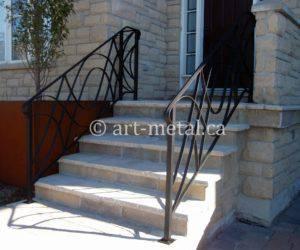
A good railing should also be made from high-quality materials that can last a lifetime. It should also be cost-efficient in terms of maintenance and repair. In choosing the best material for your ideal railing system, one should look for a provider that has years of experience and state-of-the-art materials and equipment.
With all the above mentioned qualities, only one company in Ontario offers just that.
For more information about Art Metal's products and services, call 416-848-4588 now!
Exterior Railings
Railings Installation, Code, and Safety Measures – Explained in Full
Despite the add-on value they provide in terms of aesthetics and curb appeal, exterior railings are foremost a safety feature to protect homeowners and pedestrians.
Whether they are installed on decks, platforms, landings, porches, balconies, gondolas, and exterior stairways, the main purpose remains of keeping inhabitants and guests safe.
In that sense, they should be highly functional and must be designed as intended.
With the right fabricators, however, you get the best of both worlds as they not only guarantee the safety of users but they also get the aesthetics part covered.
Definition of Different Railings
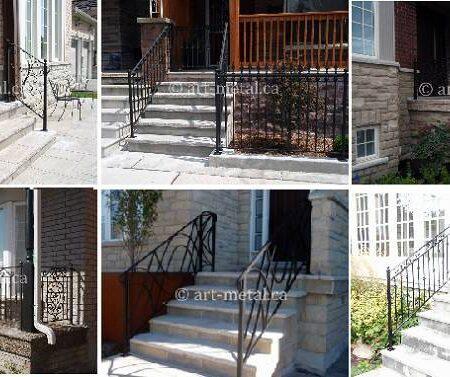 Both the handrails and guardrails are being used interchangeably. But are they really the synonymous?
A guardrail is a whole structure to make sure that people do not fall off the platform, landing, and walkway perched several meters high.
A handrail, meanwhile, is a metal, wood, or aluminum construction with the main purpose of providing stability to the person walking up and down the stairway, step ladder or ramp. A handrail could be a component of the guardrail.
The two also differ in their strength. For instance, the handrail should be strong enough to make sure the user doesn't fall when he holds the frame. The guardrail, meanwhile, needs to be solid and stable to support the full weight of a person or a number of persons as they lean against the construction.
Stair railings, on the other hand, work exactly as they sound. They are fabricated out of steel, metal, wooden or glass materials to form a support for anybody going up the stairs, or serve as barrier to prevent anybody from falling.
Building Codes for Railings
For stair railings, the building core requires exact specifications for residential and commercial establishments.
For instance, a railing should be installed to protect the users if the rise of the stairs goes over three feet. For handrails in Canada, the height should be 32-36 inches above the stairs. This is lower than what is typically used in the United States, which ranges from 34-38 inches,
The space between the railings and the wall should be 1.5 inches while the railings height should range from 27 inches to 31.5 inches.
They should be installed on:
- Balconies and porches
- Ramps
- Decks
- Stairways and step ladders
- Toilets for accessibility for disabled
- Or as specified by the inspector
For the construction, the handrails must have no breaks in the design. They should slope from above until the last riser on the floor. The only break allowed is when they are supported by the newel post.
Dimensions of the Handrail
The Building Code also sets the required dimension of the handrail.
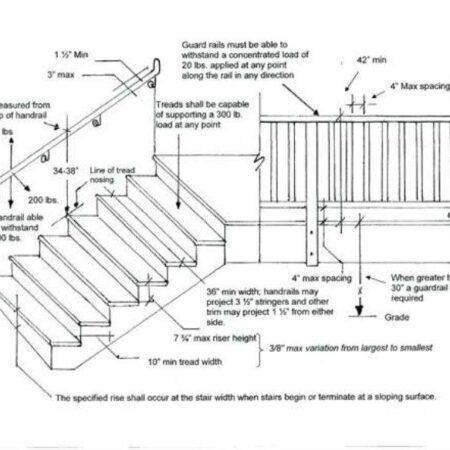 The handrail should be designed to make it easier to grasp
- This includes the size and shape
- For round rails, the diameter must not be more than two inches and not less than 1.25 inches
- For rectangular rails, the total perimeter should not exceed 6.25 inches and not fall below four inches
- If the rectangular railing is more than six inches, a recess should be installed to make it easier to grasp
(Note: the very essence of the railing is to ensure the safety of users. If they can't grasp the handrail properly because of the thick perimeter, then the whole point is defeated.)
Building Code Requirements for Guardrails
Guardrails are not always required of buildings or residences unless there's a drop of 24 to 30 inches.
It might not seem a lot but imagine if there are infants or toddlers around. Falling from that height when they have not yet developed the instinct to protect themselves can be very dangerous.
For buildings and commercial establishments, the height of the guardrail should not be less than 3.5 feet.
For residences, the minimum requirement will be three feet. The space of the metal bars in the railings should not be less than 100 millimeter between them or about four inches.
How Strong Should the Guardrails Be?
Fortunately, you don't have to guess because it's also outlined in the Building Code.
- For the balusters or panels, they should be able to support 112 pounds per foot of force
- For the top load, it should be able to support 103 pounds of force per foot
- For exterior guardrails that are being used by two dwellings, the concentrated load should be around 225 pounds
- For exterior guardrails in areas where people do not usually mingle, the load is also set at 225 pounds
Of course, the experienced manufacturer of guardrails and handrails know the Building Code like the back of their hands.
This makes it easier for you to pass the inspection with flying colors.
Requirements of the OSHA on Handrails
The Occupational Safety and Health Administration has a strict regulation on handrails.
According to its standards, the handrail must be strong enough to support the employees who are grasping at it for stability when walking up and down the stairs, ramp, deck, or landing.
- The handrail should be strong enough to support at least 100 kilos of weight if a person will lean forward or backward on the top edge
- For spiral staircases with tread of six inches or less must have a continuous handrail
- If the handrail is not yet permanent, the specification should be three inches from the wall
- A stairwell with four or more steps should have a handrail
- The distance between the height of the handrail and the riser should be from 30 inches and 37 inches
Some employees may take the shortcut and cut costs by installing PVC pipes as handrails. In terms of graspability, the PVC pipe passes muster. You can certainly grip the tube without a hitch.
However, the construction won't pass the standards in terms of strength and durability. The PVC pipe will tend to drop in the long run, and then you have a sure red mark when the building inspector comes calling.
STAIRWAY FEATURES THAT ARE DEEMED UNSAFE:
- The location of the handrail in relation to the stair or ramp
- The handrail being too high or too low
- No handrail to speak of
- Non-graspable because of the thick perimeter
- The space between the handrail and the wall (either too close or too far)
- Handrail not strong enough
- Mediocre fabrication
OSHA Requirements on Guardrails
The OSHA requires the worksite to have guardrails on the hazard area where the vertical drop hits six feet or more. There should also be safety nets or "fall arrest systems" for the additional protection for the workers.
For guardrails at construction sites:
- They should be between 39 and 45 inches high from the ground (although there are concessions to be made depending on the work conditions)
- Safety nets should be installed when there are walls or barriers and the drop is at least 21 inches high
- The space between balusters or bars must not be more than 19 inches
- The guardrail handhold should be smooth and free from splinters, punctures or cracks that may cause injury
- In lieu of balusters, a midrail may be installed and it should be located midway between the floor and the top edge
- The guardrail should be designed to withstand a minimum of 150 pounds of force
An OSHA inspector may flag you for violating the requirements on guardrails and handrails at the construction site.
Guidelines to Handrail and Guardrail Inspection
In Canada, safety inspectors are guided by the National Building Code of Canada. But cities and provinces also have local zoning and building codes that provide additional requirements in the construction of residential and commercial buildings.
As a general rule, if you purchased an old house, chances are that its guardrails and handrails are not compliant with the code.
This means that you will have to add the correction into your list of expenses to make sure that the guardrails and handrails are brought up to the code.
Why Aren't You Told That the Rails Violate the Code?
While in theory, building inspectors would be going around to inspect each house or place of business, the reality is that the government is drastically unmanned to realistically do this.
Most probably, the house you bought is listed in the system has having no prior violation.
Guardrails on Swimming Pools
If you have a pool or just any sink with a diameter of around two feet, you are required to put up railings in order to protect particularly small kids and toddlers from harm.
The railings should be at least four feet high surrounding the basin of water. It should be secured with a lock and key or any other security device to ensure the protection of small kids.
The space in between the balusters or bars should be closed enough to prevent kids and pets from getting through.
For the most part, exterior railings fabricators are cognizant of the safety codes surrounding swimming pools and the like. To be certain, call in an inspector to look at the exterior railings.
The Canadian building code requires that handrails should be easy to locate, even for those with vision problems. The ends of the railings should not be sharp or pose risks to the visually impaired for small kids.
- The railings should not extend more than four inches from the wall or the continuous surface.
- Exterior railings are required for single dwelling units when there are more than three risers
- Interior railings are required for single dwelling units when there are two or more risers
When Do You Need Two Handrails?
The code distinguishes between exterior railings and indoor railings.
If your exterior stairway doesn't exceed 43 inches, you can install a single continuous handrail. Also for curved exterior stairways, handrails must be installed on both sides even if you comply with the width requirement for the stairs.
However, even the tread width exceeds 43 inches, you can still install a single handrail as long as the location is indoors.
Types of Exterior Railings
There are different types of interior and exterior railings, each with its sets of pros and cons.
Wrought iron
Wrought iron is still a popular option for exterior railings because of their durability and aesthetic appeal. The drawback is that they are quite heavy. However, there are hollow rods, which address this concern.
Stainless steel
This is a less popular option in a sense that it's less malleable compared to wrought iron, which means your choices of designs are limited. On the flip side, stainless steel is more resistant to corrosion compared to wrought iron.
Aluminum
Aluminum exterior railings have overtaken wrought iron and stainless steel as the material of choice for commercial and residential applications. You have a wide selection of customization options. It's also as durable as wrought iron but much easier to install. Aluminum is light, resistant to corrosion and rust, and typically lasts a lifetime with minimal maintenance. The heat transfer is also excellent for aluminum.
Wood
Wood as material to be used in exterior railings is risky considering that it becomes brittle and fragile when exposed to the elements. It's not as durable as iron, steel, and aluminum. The only advantage is the aesthetic appeal as wood gives off that rustic and classic feel. There are also sealants available to protect the material from heat, rain, and snow.
Fiberglass
Fiberglass exterior railings are not as popular even if are highly resistant to corrosion and rust. They are also quite cheap. When property treated, they are also fire-resistant, as well. However, they don't offer the elegance and class that aluminum or wrought iron provides.
Vinyl
For a cheap alternative, there's probably no better than vinyl. It's easily fabricated and installed so you don't have to wait long for your exterior railings. It's durable and resistant to both corrosion and rust. With that said, the kryptonite of vinyl is very low temperatures, along with mildew and molds, which seem to love the material.
Handy Tips in Choosing Exterior Railings
Your exterior railings will either enhance the appeal of your home or cut the value. This is why your next decision is crucial.
Before anything else, however, check with your local safety office or the local zoning board if you are even allowed to construct a deck in your area, much less exterior railings. As you can see, there are many requirements set by the building code and even the OSHA.
Violations of the code may mean that your indoor and exterior railings may be replaced, which means additional expenses on your part unless you can manage to bring it up to code.
Companies such as Art Metal are fully cognizant of all the applicable laws when it comes to exterior railings. This will make your life easier because you don't have to worry about return jobs.
Tip 1: Don't Compromise Functionality
Your exterior railings may check all the boxes as far as aesthetic design is a concern, but what about functionality? The main purpose of the deck railing is security, especially if you have pets or small kids and the drop is substantial. Are your railings meant to secure your small kids or to keep away the prying eyes of neighbors? Each answer will require a different design.
Tip 2: Trust the Experts
Most service providers have a catalog of their previous projects. You can just pick and choose from among the designs and colors, and let the experts do their magic. This is a guaranteed headache-free option. However, they will also recommend customization options depending on what they see on your property following an on-site inspection.
Tip 3: Stick to Your Budget (With a Little Extra)
The rule of thumb is to set a contingency budget in any renovation introduced to the house. How much should this contingency budget be will depend on you; however, it's best to set aside 10% of the total cost. Anyway, you will keep the money that remains unused. Make sure to always consult with the installer so you can minimize the risks.
Tip 4: Research All the Pros and Cons of Exterior Railings Materials
You do have to perform your due diligence in order to find the right material for the exterior railings in your deck or porch. Make a shortlist of two or three materials that you think will fit your budgetary requirements while at the same time, meet your criteria in terms of looks. You can then sit down with the exterior railings expert to help you decide the right material for your home.
Tip 5: Customize Your Exterior Railings
With a variety of colors for the exterior railings to choose from, you can choose a striking contrast or a soft hue to enhance the look of your home. In the same vein, you can install some LED lights to make sure your porch or deck pop up when the sun is down. These are easy and relatively cheap additions to make sure the design stand out from the rest.
Source: https://art-metal.ca/exterior-railings/


Tidak ada komentar:
Tulis komentar